


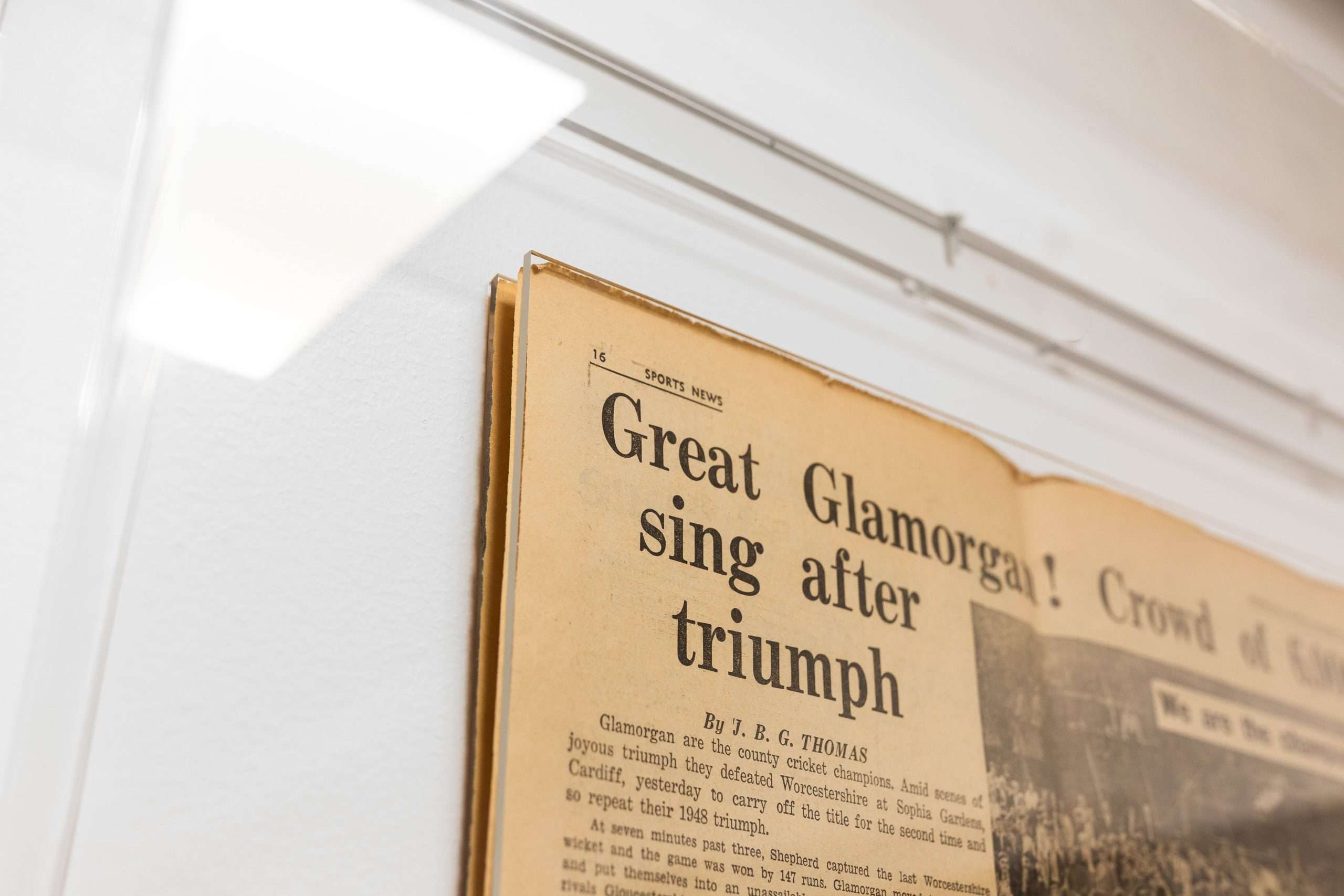
Dipec, designers and fabricators of custom museum-grade display cases, have been working with the Museum of Welsh Cricket to elevate their displays of historic memorabilia including match programs, player records, signed bats, stumps, and balls.

About the Museum
The Museum of Welsh Cricket is dedicated to telling the story of cricket in Wales in a stimulating, innovative and safe way. The museum is located in the Cardiff Wales Stadium, home of Glamorgan County Cricket Club an accredited international test cricket venue. Having opened in 2012, it became the first fully accredited cricket museum in the UK in 2018. It receives 15,000-20,000 visitors each year.
As part of the Museum’s 2025 refurbishment, Dipec were appointed to survey, design, manufacture and install a range of custom display solutions that allowed the array of artifacts to be visible, engaging and protected.


The Exhibits
The Museum’s collection includes items of clothing and equipment as worn by county and club players. Some have been acquired to provide examples of how the playing of cricket had changed and developed over the past 250 years.
The collection also includes numerous records, such as scorecards, autograph books, scrapbooks, membership cards, club records and player contracts. This collection throws a light on how the people of Wales as club officials, players and supporters contributed to the development of the game in Wales.
The displays therefore house valuable and historically important items.
The Brief
The Museum initially approached Dipec to create a new display for a set of historic bats, signed by players from throughout Welsh Cricket history. These bats needed to be displayed vertically and mounted on a glass partition, so a clear acrylic system was designed. The bats are suspended from a top-mount, locked in place, while the bottom of each bat sits in a clear acrylic saddle to keep them in place. They’re protected by a UV coated acrylic case, to ensure the exhibits are resilient to both impact and UV.
In phase two, we were commissioned to design and manufacture a wider range of bespoke display solutions, predominantly wall mounted.

Services Supplied
- Detailed surveys: Gaining a full understanding of display locations so we could accurately design solutions, fixing methods and requirements.
- Bespoke designs: Our team can more accurately design bespoke solutions once in receipt of example artifacts. In order to ensure the item is displayed with maximum clarity and security.
- Prototyping: We tested our designs before rolling out each solution to the client.
- Installation: The majority of displays were wall mounted, so our installation team managed the fitting process.
- Post-install support: Follow-up visits with the museum to check placement and fixings, and to expand display options.

The Outcome:
The outcome is a range of custom, wall mounted, clear acrylic display cases that display and protect a wide range of artifacts.
Why Are Museums Turning to Acrylic?
Many museums are replacing their traditional glass display cases with acrylic, but why?
- Acrylic is up to 17 times more impact resistant than glass, making it an excellent choice for high-traffic environments.
- Acrylic is shatter-proof and is more resilient to cracking upon impact.
- Acrylic display cases are around 50% lighter than their glass equivalent, making them easier to transport, install and reposition.
- Acrylic is also light enough to allow cases to be easily wall mounted, whereas most glass cases require robust support structures.
- Acrylic provides exceptional transparency, offering 92% light transmission, which is higher than standard glass, which also sometimes produces a green tint due to its iron content.
- Acrylic can be manufactured with UV-resistant properties, ensuring artifacts, collectibles and artwork are protected from fading or deterioration due to sunlight.
- Acrylic is highly customisable, allowing Dipec to create bespoke designs, custom shapes, tailored to each artifact. Glass is much harder and more expensive to shape and modify.
- Our acrylic displays can be fitted with bespoke features like locking mechanisms, illumination, printed elements, and brandingdirect to the surface.
- Acrylic is generally more cost-effective than glass.
Why Choose Us?
Since 1981, Dipec’s expert designers and craftsmen have been fabricating quality display cases for museums across the UK and beyond.
In 2025, Dipec became an approved supplier to the Association of Independent Museums.
- We’re UK-based, and source our materials from the UK, so we manufacture to strict quality standards, and our timeframes are shorter than many of our oversees competitors.
- We’ve been manufacturing bespoke acrylic displays for over 40 years, so we are happy to advise you on the most suitable materials, designs, manufacturing methods, and finishes that will best display and protect your artifacts.
- We’re an approved AIM supplier (Association of Independent Museums).
- We pride ourselves on our unbeatable service levels, always honest, finding solutions that best match client needs.

If you’d like to find out more about custom display cases, or anything else mentioned in this article, please just reach out on: 02920 598393, sales@dipec.co.uk or by completing our online contact form.


